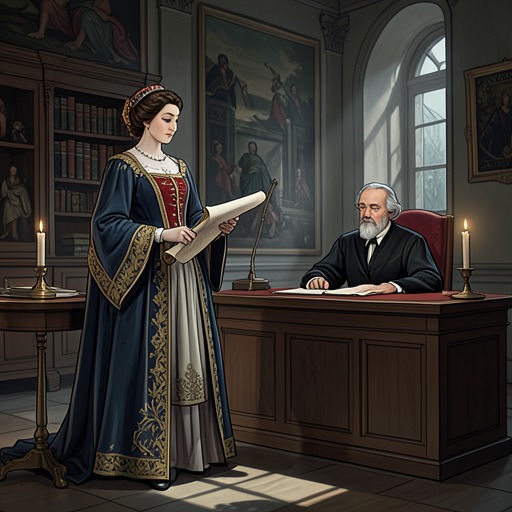
Elizabeth Báthory–Ferencz Nádasdy marriage
A History of the Vampire in Popular CultureThe Elizabeth Báthory–Ferencz Nádasdy marriage was a politically and socially consequential union between two wealthy Hungarian noble families. It gave Elizabeth access to exceptional education, property, and authority, and later became inseparable from the contested stories that portrayed her as a vampiric murderer who bathed in blood to preserve her youth.
Marriage and Social Position
Elizabeth Báthory married Ferencz Nádasdy when she was fifteen. The marriage connected her to one of the region’s oldest and richest families, and the couple moved to Čachtice Castle in Slovakia, which Elizabeth received as a wedding gift from Ferencz and the Nádasdy family. They had four children according to some accounts, though other versions give three or five, illustrating how even the basic biographical record has been filtered through contradictory later traditions.
The marriage also carried an unusual symbolic detail: Ferencz agreed to take Elizabeth’s maiden name because the Báthory name was regarded as more illustrious than his own. This was not merely a domestic choice. It signaled the prestige of Elizabeth’s lineage and placed the marriage within a world where family reputation, inherited wealth, and political position were closely bound together.
Authority During Ferencz’s Absence
Ferencz fought in the Long Turkish War, which began in 1593 and involved Wallachia, Transylvania, and Moldavia. During his absences, Elizabeth was entrusted with responsibility for defending his estates. The task was substantial because the properties stood along the politically important route to Vienna and had previously been plundered by Ottoman forces.
Elizabeth’s authority extended beyond military and property administration. The evidence presents her as taking responsibility for the welfare of people living under her jurisdiction, including destitute women. In one reported case, she intervened on behalf of a woman whose daughter had been raped and impregnated. Such anecdotes complicate the later image of the countess as a figure defined only by cruelty: they portray a powerful estate-holder exercising judgment within a rigidly hierarchical society, sometimes using that authority to address the vulnerability of people beneath her.
From Noble Marriage to Blood Countess Legend
Ferencz died after dropping dead during a battle from an unknown illness rather than being killed by combat itself. His death left Elizabeth one of the richest and most powerful people in the region. That change in her position altered the political meaning of the marriage. Her wealth and influence made her a potential ally of her cousin Gabor, who sought the throne; an alliance between them could have threatened other claimants to power.
After Ferencz’s death, rumors about Elizabeth intensified. Earlier accusations had circulated since the beginning of the seventeenth century, and some may have grown from the violence used to control hundreds of servants and manage extensive lands and property. Later stories, however, became extreme: servants were allegedly beaten to death, flesh was supposedly cut from victims’ bodies and made into food, and some victims were said to have had their lips and tongues sewn shut.
The most famous version claimed that Elizabeth murdered young women and bathed in their blood to preserve her beauty. This story made her the archetypal Blood Countess: an older woman whose vanity supposedly turned youth into an object of consumption. The evidence stresses that the legend is almost certainly false and that there is no reliable basis for treating the blood-bathing tale as an established fact.
Power, Gender, and Historical Memory
The marriage is crucial to understanding why Elizabeth became such a potent figure in vampire folklore. She was not simply a secluded criminal or an isolated supernatural villain. She was highly educated, exceptionally wealthy, connected to a ruling family of Transylvania, related by birth to the King of Lithuania-Poland, and powerful enough to administer estates and intervene in local affairs. Her authority exceeded what many people expected of women in a strongly patriarchal society.
The later legend converted that social unease into a moral fable about female power. Elizabeth’s wealth, political independence, and control over servants were recast as evidence of unnatural appetite. The story’s vampiric logic—youth preserved by consuming the vitality of the young—made a woman’s age, beauty, and authority the central objects of judgment. In that transformation, the marriage became more than a record of aristocratic alliance: it became the opening condition for a contested historical memory in which real privilege, rumor, political rivalry, and misogynistic fantasy were fused into the image of a monstrous countess.